Around 3,000 years ago, cocoa beans were originally used in a wide variety of ways by the Mayan, Toltec and Aztec civilisations. Cocoa beans could be eaten raw or as a beverage, or dried and used as money and a unit of exchange. This money continued to be used until colonial period. The Aztecs used to make drinks flavoured with cocoa and plants for religious rites and major festivities. In the 16th century, cocoa beans imported to Europe by the Spanish were ground to make a bitter drink. Arriving in France in the 17th century, cocoa consumption evolved. Over the centuries, cocoa was transformed into the chocolate we know today. Today, more and more of you are interested in cocoa beans, raw or roasted, for their taste and health benefits.
The cacao tree is the origin of chocolate. Of the genus Theobroma, it is an endemic tropical species native to equatorial forests with a hot, humid climate. Although the trees can grow up to 15 metres high, today they are trimmed to a maximum of around ten metres to make it easier to harvest the fruit.
How cocoa beans grow?
The cocoa tree produces a very large number of small white flowers (thousands), only a few of which are fertilised and bear fruit. Known as cocoa pods, these fruits grow on the branches of the tree, or directly on the trunk. Oval-shaped and elongated, they measure between 10 and 30 cm in length. Depending on the variety, the pods change colour from green/purple to yellow/orange when they reach maturity. Cocoa has the distinction of being one of the largest fruits in the world after a total of 5 to 7 months of maturing.

Cocoa pods contain seeds: cocoa beans.
Did you know that?The pods contain an average of 30 to 50 cocoa beans. Fresh cocoa beans look like oval pulp seeds. Tender, they are covered in a sweet, slightly viscous mucilage. The beans have different aromas and flavours depending on the variety of cocoa tree: Forastero, Trinitario, Nacional, Amelonado, Criollo, etc.

Cocoa pods are picked from cocoa trees by farmers with machetes. To reach fruit out of range, they use a long stick to which a sharp tool is attached. The shell of cocoa pods is hard and thick. With a precise movement, the producer breaks the cocoa pod with a machete to extract the precious cocoa beans. This step generally takes place in the shade of the cocoa trees, directly on the plantation. The fresh beans are separated by hand and stored in a bucket or bag. When fresh, they are enveloped in a white pulp called mucilage. You can taste the freshly shelled beans and the juice that goes around them. The pulp has a deliciously fruity, tangy flavour.

The extracted cocoa beans are then fermented. This stage is crucial for developing the flavours of the cocoa beans. The protocol is precise and rigorous in order to obtain high quality cocoa beans. Traditionally, these beans are fermented directly on the plantation in banana leaves. But this method has many shortcomings and does not allow us to control the quality of the beans. At Kaoka, the beans are fermented in specially adapted structures. They are immersed in large wooden vats where they are stirred and aerated regularly to ensure controlled fermentation. Fermentation is divided into two distinct stages:
Brewing and temperature control throughout the process are decisive factors in the aromatic quality of the chocolate. Poorly fermented cocoa beans will give chocolate aromatic defects.

Once the cocoa beans are fully fermented, they are taken out of the fermentation crates and spread out in solar or gas dryers for a period of two to three weeks. Drying the cocoa beans is the essential step in ending the fermentation process. Solar dryers are generally large, well-exposed wooden surfaces. The cocoa beans are stirred very regularly using large rakes. Drying allows the polyphenols to oxidise and the excess acetic acid to evaporate.
Optimum drying is essential to avoid the risk of mould during transport, which would spoil all the work done beforehand.
After fermentation and drying, a whole bean measures between 2 and 3 cm long and 1 to 2 cm wide. It is brown in colour, with a slight purplish tinge.
In Raw Food, food must not be heated above 42°C to be considered raw. Beyond this temperature, the nutritional qualities could be altered. Over the last few years, we have seen more and more ‘raw cocoa‘ products emerging. However, to be a purist, raw cocoa can only correspond to fresh cocoa, i.e. cocoa that has been freshly de-bibbed. Fresh cocoa then goes through the fermentation and drying stages, where it is subjected to temperatures above 45°C. During the fermentation phase, the cocoa will reach around 50°C. The temperature also rises during the cocoa drying phases (in solar or gas dryers).
Even so, a cocoa bean that has not yet been roasted will offer better nutritional and therapeutic properties than a roasted bean. Unlike chocolate, a cocoa bean is considered a superfood: it contains no added fat or sugar.
There are different ways of eating whole cocoa beans. Some people eat them whole without shelling them, but we advise you to remove the cocoa shell (the thin dry film that covers the bean) for optimum enjoyment.

How do raw cocoa beans taste?
Neither salty nor sweet, raw cocoa beans reveal slightly bitter and very fruity notes when tasted. They go equally well with sweet and savoury dishes.s.
The cocoa beans are roasted in large metal cylinders, i.e. they are roasted while being stirred regularly with large circular movements. Roasting reduces the bitterness of the cocoa beans and brings out the cocoa’s aromas.
After being roasted, they are then crushed and separated from their shell. This is how we obtain cocoa nibs.
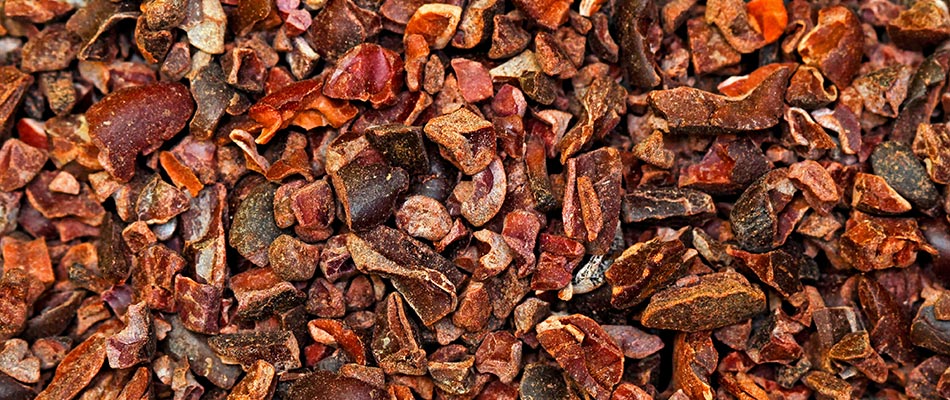
Le grué de cacao correspond donc à des éclats de cacao torréfiés. Ces éclats ont une texture croustillante très agréable en bouche. S’il est vrai qu’ils n’ont pas le goût du chocolat, ils offrent une délicieuse saveur de cacao grillé. Le grué de cacao est une matière noble qui permet d’agrémenter de nombreux mets : aussi bien sucrés que salés.
Cocoa nibs are roasted cocoa nibs. These chips have a crunchy texture that is very pleasant on the palate. They may not taste like chocolate, but they have a delicious roasted cocoa flavour. Cocoa nibs are a noble material that can be used to enhance a wide range of dishes, both sweet and savoury.
Cocoa nibs can be sprinkled on many sweet recipes. It goes perfectly with a wide range of fruits and adds an irresistible crunch to any dish:

Theoretically, yes! It takes a bit of time and organisation, but in reality, it’s not impossible!
If you’re using whole cocoa beans, you’ll need to roast them in a pan, shell them and then grind them finely to obtain a cocoa paste. If you are using cocoa nibs, simply grind them as they have already been roasted and shelled.
The cocoa paste should be smooth and homogenous. This paste is the basic ingredient of chocolate. You can then create your own chocolate recipes:
cocoa beans Vietnam, cocoa beans exporter Vietnam, bulk cocoa beans Vietnam, cocoa beans competitive price, cocoa beans stable quality, Vietnam Cocoa Beans Supplier